
Ever wondered what it is like to be a Premier League referee?
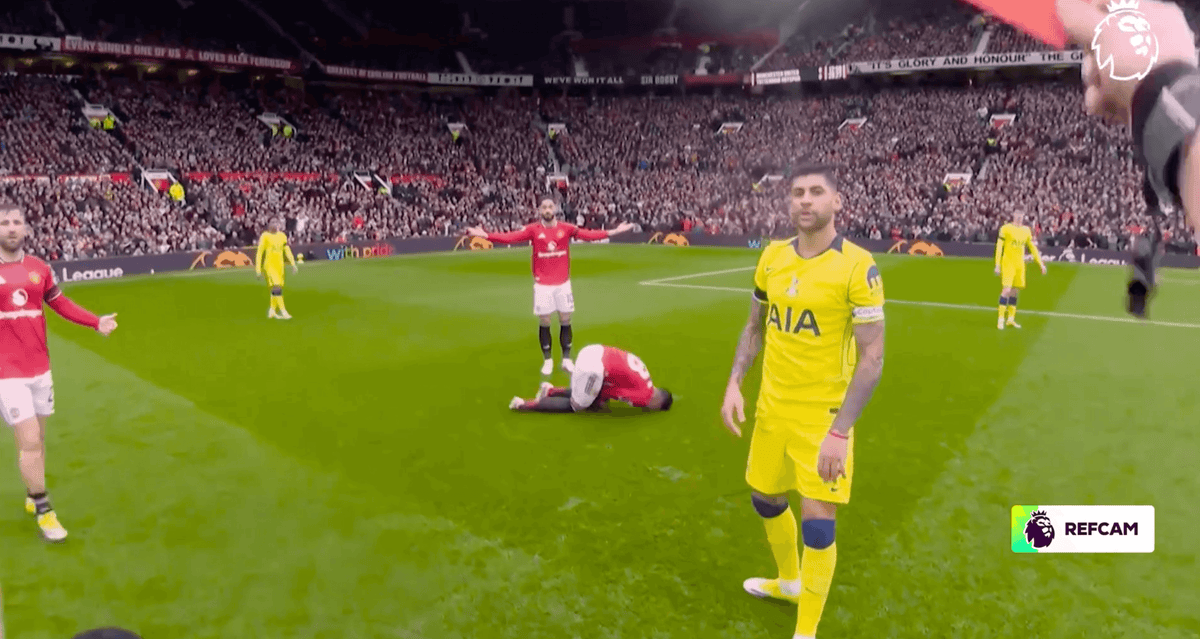
The ref cam, attached to the match official’s right ear, showing their point of view, has given a new insight into a referee’s perspective in the top flight this season.
After trials in pre-season friendlies during the United States-staged Summer Series two years ago, and a league match between Manchester United and Crystal Palace in May 2024, this campaign’s rollout has been more comprehensive.
As well as brief cuts to the camera during live game coverage, we are now seeing mic’d up edits posted to the social channels of the Premier League and its broadcast partners, which often feature confrontations and decisions that have become larger talking points.
It is content we are likely to see more of, with FIFA deeming its own ref cam experiment at last summer’s revamped Club World Cup in the U.S. to have gone “beyond their expectations”. Those cameras will be used at all 104 World Cup matches in the U.S., Canada and Mexico this June and July, while it has also been introduced in the NWSL, the U.S. women’s top-flight, and featured last weekend in the final of Spain’s Copa del Rey between Atletico Madrid and Real Sociedad.
From dealing with West Ham United winger Adama Traore bulldozing Chelsea players to intriguing exchanges in the Merseyside and north London derbies, here are eight things it has shown us from behind the curtain.
The human side of referees
Nobody thought officials were aliens, but the ref cam puts you in their shoes.
You see the impressive speed at which players get around the pitch and decisions on incidents get made, and the task facing referees, who have to keep up with moves being executed by people who are often many years younger than them and in their physical prime.
We have even seen some banter between referees and players. During Manchester United’s 2-0 home victory against Tottenham Hotspur in February, Michael Oliver joked with Spurs midfielder Conor Gallagher that he might have scored from one chance if he’d taken a better first touch, as seen below.


Another example came in last weekend’s Merseyside derby.
After James Tarkowski disputed a foul given against his Everton side, Chris Kavanagh jokingly asked the 33-year-old centre-back if he is going to become a referee once he retires as a player.

The players who test officials’ patience
From the footage released so far, West Ham’s Matheus Fernandes and Victor Lindelof of Aston Villa have had the frostiest confrontations with referees.
During Chelsea’s 3-2 comeback victory against them in January, West Ham won a free kick on the edge of the penalty area. Fernandes began pestering the players forming the wall and was met with an “Oi, excuse me” intervention from referee Anthony Taylor.
“Do not come here causing problems. Stand there, and don’t speak to anybody,” Taylor continued, with Chelsea’s Moises Caicedo also berated during that incident.
At one point in Villa’s 2-1 defeat of his previous club Manchester United in December, Lindelof could be heard saying “I didn’t touch him” to Oliver, not realising the official had penalised another player. As Oliver explained the situation to Lindelof, the Swedish defender walked away.
@premierleague This is amazing insight 😮 Watch a Premier League match from the referee’s POV, when Aston Villa hosted Man Utd in December 🤳 #PremierLeague
Ninety-plus minutes of match footage gets edited down to about two minutes before it’s released, so the fiercest protests are unlikely to make the cut. We saw Everton goalkeeper Jordan Pickford booked during last Sunday’s defeat against Liverpool for dissent, but the mic did not pick up what the England No 1 said.
Equally, there is clearly respect between the players and the officials. Mohamed Salah and Kavanagh shared a nice exchange at the end of the same match. The referee told the soon-to-depart Liverpool forward “(A) pleasure, Mo,” to which Salah replied, “If I don’t see you, it was a pleasure.”
What really happens in heated moments
One feisty moment caught on ref cam during that same Chelsea-West Ham game was when Traore tussled with Marc Cucurella and Joao Pedro.
The first question Taylor asked the VAR officials via their audio link was if Traore had pulled Cucurella’s hair (he did not; he just helped him to the ground). Joao Neves of Paris Saint-Germain was sent off in the Club World Cup final for pulling the Spanish defender’s hair last July, as was Southampton’s Jack Stephens in the Premier League in December 2024.
All this happened towards the Chelsea corner flag, but West Ham midfielder Tomas Soucek saw the funny side of it and asked the ref if it was a possible penalty. “Come on, Tomas,” Chelsea captain Reece James responded.
During the ensuing melee, West Ham defender Jean-Clair Todibo grabbed Joao Pedro’s neck. “You’ve gotta check VAR though,” Chelsea’s Cole Palmer told Taylor.
We then saw Taylor go over to the monitor. “Oh, yeah. Grabs him round the throat,” he said, before showing Todibo a red card.


The best view of the goals
Referees have to try to position themselves in line with play to keep up with the unfolding match action.
This has meant they have regularly enjoyed the perfect vantage point for some of the best goals scored this season, such as Dominik Szoboszlai’s winning free kick for Liverpool against Arsenal in August.

In the mic’d up content, Oliver was right on top of Morgan Rogers’ two goals for Villa in that December match against Manchester United, both scored from the left side of the box. So much so that he could see the flight of the shot and said “Goal” on each occasion before the ball had hit the back of the net.
Over recent weeks, there have been similarly satisfying angles of Alex Scott’s winning team goal for Bournemouth against Arsenal and Cody Gakpo’s inch-perfect pass to Salah against Everton.
Kolo Muani controversy
In the footage from the north London derby in February, we saw the disallowed Tottenham goal against Arsenal in which Randal Kolo Muani was deemed to have pushed Gabriel in the back before putting the ball in the net.
His team-mates Micky van de Ven and Gallagher protested the decision, but referee Peter Bankes ended the discussion by saying, “It is a clear foul. End of.”


Some fans reshared the images and said the referee’s view of the incident was not clear. This is where ref cam has its limitations, as it does not have full peripheral vision.
Whether you believe it was a foul or not, Bankes’ on-field decision was that it had been, and VAR did not deem it a clear and obvious error — even if Gabriel’s fall from the push appeared rather soft.
VAR is all-encompassing
Watching just the ref cam clips, which are sometimes less than two minutes long, gives you an indication of how much refereeing now centres on VAR.
Whether this is a good or bad thing depends on your view of the technology, but every goal being met with the statement “on-field decision is goal/no goal” gives you a sense of where things stand.
In the clips, referees can be heard giving small updates and communicating with their VAR colleagues, who can be hundreds of miles away, as much as they do with the players surrounding them on the pitch.
Romero predicts the future
At the start of Premier League games, referees carry out a coin toss with the two teams’ captains to determine who kicks off and which end of the pitch they want to attack to start.
At the start of that Manchester United win against Tottenham in February, Oliver took out a coin with red and silver sides. Referring to Romero by his nickname, ‘Cuti’, Oliver asked the Argentina centre-back to pick a side. He opted for red, with a grin on his face.
Twenty-nine minutes later, Romero was shown a red card for a high challenge on Casemiro.
“It’s finished — red card,” Oliver said. “They’ve already checked it?” asked Van de Ven, Romero’s fellow defender. Oliver repeated his initial statement three or four times afterwards.


Should it be used more?
At the end of Manchester United’s Villa Park defeat in February, an out-of-view player for the home side could be heard telling Oliver, “Hey, you should have a camera at every game. You’ve been flawless.”
In other sports, such as rugby union, referees have been mic’d up in matches since the early 2000s, and it has proved a popular and successful development.
Football has been late to the party, but the fact that it will be used at the upcoming World Cup, among other competitions, suggests it is now here to stay.
All screengrabs: Premier League RefCam




Leave a Reply