
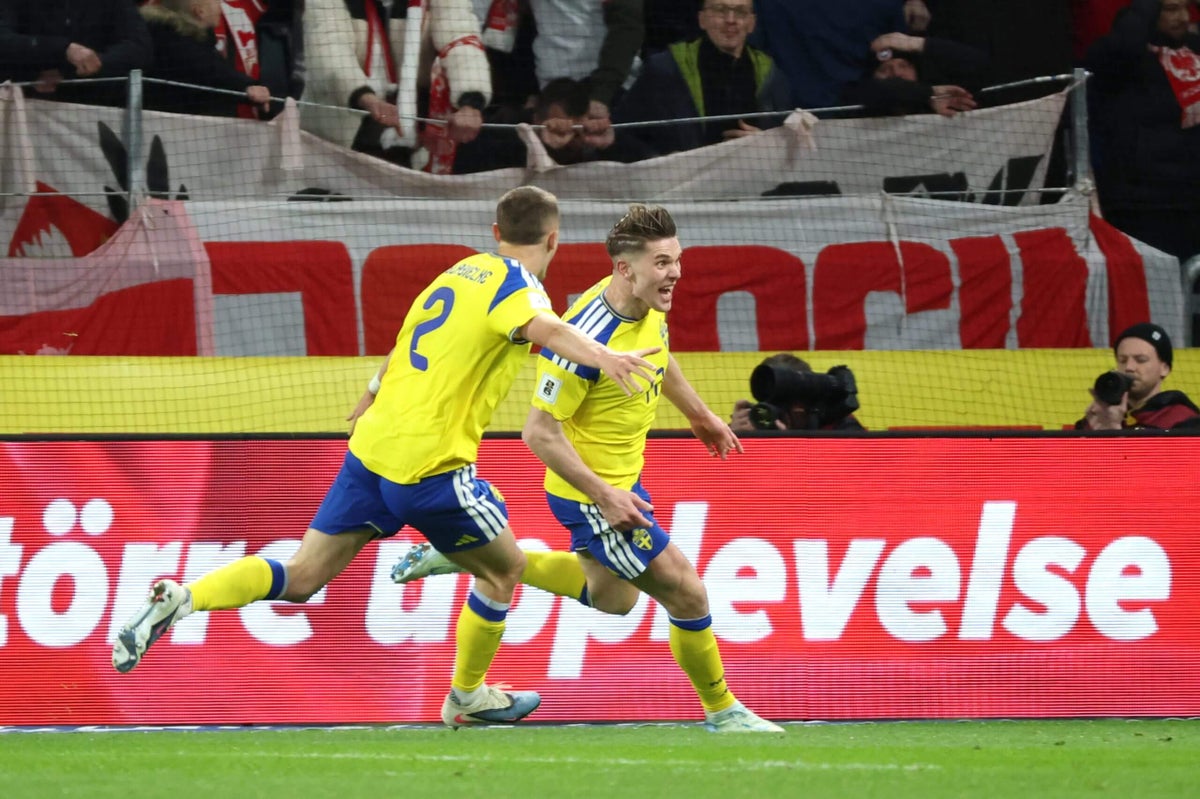
“We’re not giving our best, we’re not fully focused on defence and passing,” Viktor Gyokeres exclaimed in October after Sweden fell to yet another qualifying defeat. “This has to do with attitude. We didn’t deserve anything. Of course, it’s a fiasco.”
At that point, Sweden were winless and bottom of their World Cup qualifying group. Now, four months later, his shirt off, a grin plastered on his face, and chased by the entire Swedish team, he is sprinting towards this summer’s World Cup.
It is seconds after Sweden’s 3-2 win over Poland, propelled by Gyokeres’ 88th-minute winner. Newcastle United winger Anthony Elanga has found a flag from somewhere and is running around the pitch like a toddler. Brighton & Hove Albion’s Yasin Ayari, born a few hundred metres away from this stadium, just stares upwards as he sprints. Graham Potter wanders onto the pitch alone.
“It was like an out-of-body experience,” said the English head coach, hired by his adoptive nation six months ago to save their World Cup dreams. “I’m looking at the goal, then, all of a sudden, most of our bench are running onto the pitch. And I’m just thinking: ‘Am I really here?’.”
At the other end of the pitch, Robert Lewandowski sits crouched on his haunches, eyes looking everywhere and nowhere, their nothingness saying everything. His mask sits slackly around his jaw. At 37, this was surely his final World Cup campaign.
How did we get here? Gyokeres did what Lewandowski could not. In the 80th minute, a Polish corner clattered around the Swedish box. The Barcelona striker was a toe away from giving his country their first lead of the night. But the ball didn’t drop.
Locked at 2-2, the game was nearing stoppage time when Gustav Lundgren beautifully stood up his man to drive towards Poland’s goal and cut the ball back. Daniel Svensson’s shot was blocked. Lucas Bergvall drove a low effort with the outside of his boot. Saved. Arber Zeneli looped the rebound goalward. Post.
And there came the ball towards Gyokeres, bouncing gently and sitting up, close enough at six yards out that the striker knew before hitting it that he was about to live his dreams. Shrugging off Przemyslaw Wisniewski, he chested the ball down before firing it high into the Stockholm sky, its progress only stopped by the roof of the Poland net.
“It was indescribable,” he said. “It takes a few seconds before you understand what has happened. It’s just a relief and a joy.”

Viktor Gyokeres celebrates the decisive goal (Michael Campanella/Getty Images)
This has been a gruelling qualification for Sweden, the sort of campaign that puts wrinkles on faces and P45s in the post. Potter replaced Jon Dahl Tomasson after the country finished with a record of two draws and four defeats in their qualifying group. They only reached the play-offs by winning their group in the Nations League’s third tier.
Despite boasting an array of talented attackers — such as Gyokeres and injured pair Alexander Isak and Dejan Kulusevski — Sweden had failed to qualify for their past two major tournaments. They had lost against Poland in a play-off in 2022, missing out on a place in Qatar.
Hired in October, Potter has turned the ship around by reintroducing Sweden’s defensive fundamentals. The team had looked wide open under Tomasson. Potter’s contract was short-term with one goal — win two play-off games to get Sweden to the World Cup.
“It’s weird,” Potter told reporters in his post-match press conference, his two sons sitting in Sweden shirts in front of him. “I’ve spent the last four or five months thinking about two games of football in March. Now I’m going to have to work out how to live without thinking about them.”
The first of those had been ticked off on Thursday evening, with Gyokeres scoring a hat-trick against Ukraine as part of a superb team performance. Images of the Swedish team drinking beer after the game, however, led to accusations from the Polish press that they thought they had already completed the job — in conversations on the streets of Stockholm, the home fans were comfortable in calling themselves favourites. Potter, for his part, insisted his team deserved one or two beers for a job well done on the night.

Benjamin Nygren, Gustaf Lagerbielke and Lucas Bergvall celebrate Sweden’s victory (Michael Campanella/Getty Images)
Anything would do to calm the nerves. For a nation starved of World Cup football — this will be just their fourth appearance since 1994 — the play-off final is a far more frightening game than any group stage match in the tournament itself.
Elanga’s 19th-minute opener looked to have Sweden on their way, assisted by a backheel from Ayari in which the diminutive midfielder leapt in the air and pivoted to his left, his only point of contact with the ground being the millisecond in which he flicked the ball between his own legs. Elanga’s finish crashed off the bar and in.
Poland equalised 15 minutes later after meek defending and weak goalkeeping allowed Nicola Zalewski to curl into the far corner, before centre-back Gustaf Lagerbielke’s near-post header on the stroke of half-time restored Sweden’s advantage. Lagerbielke — or more accurately, the 11th Baron Lagerbielke — is a member of the Swedish nobility and lies 254th in line to the Swedish throne. He may have risen a few places after Tuesday night.
But Poland were not done. Karol Swiderski’s 55th-minute equaliser was deserved, with the visitors looking likelier to win the game throughout the second half. At points, Gyokeres was playing like a fourth centre-back — his main contributions were coming as an auxiliary defender from Polish set pieces, rather than in attack, with Bergvall frequently the only Swedish player daring to burst forward.
The pair have experienced odd seasons. Bergvall, despite injuries, has played well for a struggling Tottenham Hotspur team, while Gyokeres, without truly excelling, is part of an Arsenal team flying towards the Premier League title.
As the starting striker of the Premier League leaders, whose long search for a striker finally ended at his door last summer, he is one of the most hyperexamined players in world football. Having not scored in qualification before this window, he was facing similar questions on the international stage.
Asked in the build-up to the World Cup play-offs whether he felt the pressure, Gyokeres had replied: “There’s always something.”
In truth, he had another quiet game at the Strawberry Arena — virtually anonymous until the game’s dying moments. He had just 23 touches, and only two of them in the Poland box — his goal was his only shot of the game. Standing on the sideline, Potter never considered taking him off.
“There was zero chance of that happening,” Potter said. “He can score at any moment. You don’t take those players off. They’re too important. Even if he’s not at his top — it’s very difficult to do that every week — he can still contribute. And he gets the winner after scoring three in the week.”
Gyokeres will return for Arsenal’s run-in with the confidence that only goalscoring can bring. He could still win three trophies over the next two months — with the World Cup waiting at the season’s end.
“It’s very exciting. To go to the World Cup in this way is incredible,” Gyokeres said. “To perform like we did in these games is amazing. Having the World Cup in the summer, as well as all the competitions we’re in with the club is really exciting, it’s great to be in that position both individually and with the team. I’m really looking forward to it.”
Gyokeres held up Potter’s post-match team talk, busy being serenaded by the Sweden fans to the tune of KC and The Sunshine Band’s Give It Up after missing the initial celebrations to give television interviews. What did Potter say when his striker finally joined?
“I said we’d spoken about how we had to show ourselves as a team. We did that tonight. And then I just said: ‘We’re going to the World Cup baby’.
“And then we started to jump around.”



Leave a Reply