
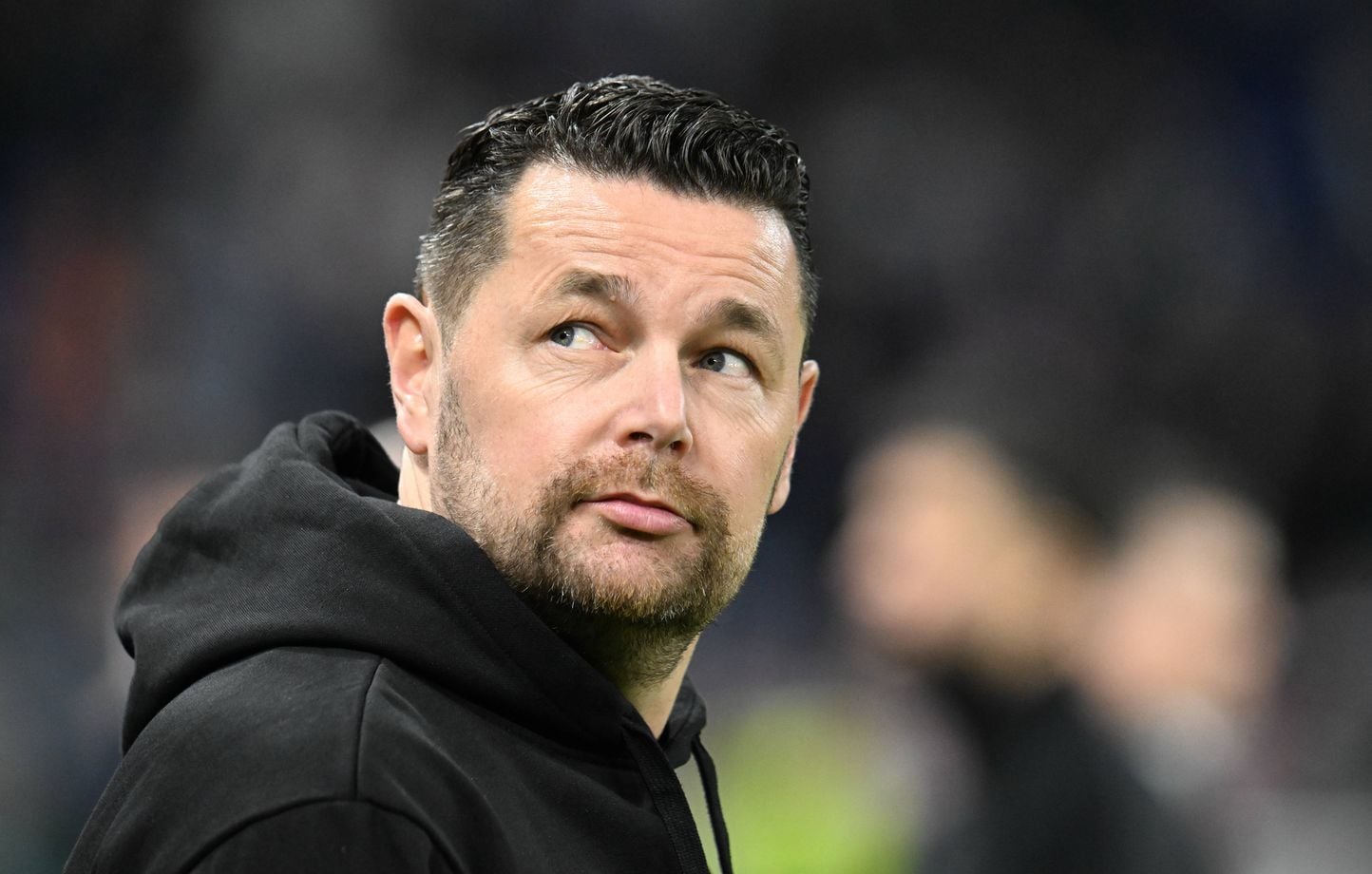
When they arrive at a new club, most coaches spend their days locked in their office putting an action plan in place. Pierre Sage, for his part, preferred to go out for some fresh air. At the start of the season, the Lensois neo-coach visited the historic mining center of Lewarde on his own, which traces three centuries of coal mining in the region, visited the Muriel café, a true institution for Lensois supporters for half a century, before spending time in other places emblematic of local culture.
Way to understand where he was going. And to buy the sympathy of supporters inexpensively? It would be a poor understanding of the man who, according to those who knew him, simply sees his job as a whole. A particularity which largely explains a start to his career unanimously considered very successful, at OL for a little over a year then now at RCL, which he guides this season in an improbable title race against PSG.
“He has very good situational intelligence. When he arrives in an environment, he perceives the elements, he is able to analyze very quickly to understand the levers and adapt perfectly,” says Franck Thivilier, one of the people who have been most important in his career.
Responsible for the BEPF (Professional Football Coaching Certificate) for 10 years, instigator of the ultra-modern Clairefontaine research center, Thivilier is a technician who is a reference at the international level. He knew Sage at the turn of the 2010s, when he worked in the Rhône-Alpes League, and immediately perceived something different in the man who was then the (very) young sports director of FC Bourg-Péronnas.
As proof, he did not hesitate to regularly ask him to intervene on training courses. “He was one of the technicians who asked questions, had thought about the activity and was able to talk about their club experience clearly,” explains Thivilier, now performance director for the Saudi Federation. Communication is something natural to him. »
Curiosity
In all this panoply, curiosity seems to be the main driving force for the native of Lons-le-Saunier (Jura), a former amateur-level goalkeeper before embarking on the management path when he was barely in his twenties. It is she who will push him to explore all possible avenues, which will lead him to occupy functions as varied as recruiter (Châteauroux), DS (CS Belley, US Oyonnax and therefore FC Bourg-Péronnas), assistant coach (U19 of Annecy, Lyon – La Duchère, Red Star) and number one (Chambéry, U16 of OL), before the big leap into the elite for which he had prepared for twenty years.
All while having transformed what could be perceived as a weakness into a great strength, observes Franck Thivilier:
« When you come from the amateur world, you are not legitimate among the professionals. And we never will be. On the other hand, we can become credible. Credibility is every day, everything you do, the way you act, the way you behave. It’s the expertise, the outlook. That will be your added value, you bring something that others are not capable of doing. »
In the numerous interviews given by Pierre Sage on the game and the coaching profession, the Lensois coach often refers to the work of Jean-Francis Gréhaigne, doctor in STAPS and one of the most recognized French researchers on football. The latter manages to show like no one else how this sport is “intelligent and complex”, praises Sage.
The two men met several times. And we can say that the student arouses the admiration of the master. “He seeks knowledge everywhere, through contacts with his peers, his travels, visits to clubs, then through his readings,” appreciates Gréhaigne. And above all, he then incorporates them into his work, by testing. He uses the training sessions as an experimental field. »

Without being a “mentor”, the academic provided a solid foundation on which the technician brought his own sensitivity.
“He adopted the systemic approach, that is to say that when we move something, we move the whole,” develops Gréhaigne. And the whole thing is constantly evolving. The second idea is that of the balance of power. Nothing can be understood without understanding oppositional relations. For example, just because you are given the composition of a team does not mean you will know how it will play. »
This method, which can be described as global, Pierre Sage himself talks about at length in an interview published on the “Entrainement football pro” site last April. “Few of them are able to explain the theoretical expectations on which they are based. He does it,” continues the researcher. This pleasure in teaching is striking in the former OL player. The short sequence in which he discusses tactics with a young Racing supporter, broadcast at the beginning of March by Ligue 1 +, was widely praised in the industry and on the networks.
Journalist Alicia Dauby, who followed several Lens matches from the sidelines this season for the League channel, has nothing but compliments to say about the coach’s attitude. “A joy” for the profession, she smiles. “With him, there is never any apprehension. You know in advance that when he gets to your microphone, he will always be open, friendly, and above all ready to talk about the game, in an ultra interesting and accessible way, appreciates our colleague. In addition, he is even-tempered, whatever the result, always very respectful. »
From her privileged position, she was also able to observe the way he speaks to his players in the heat of the moment. “Always looking for details”, Sage is not the type to drown his team in an endless stream of words. “It’s really a few precise instructions, distilled throughout the match, and without ever shouting,” continues the journalist. In the privacy of the locker room, the accuracy of words is also highlighted by his players.
More than the method, “consistency”
From this point of view, another notable sequence of the season is the video of his talk at half-time of a match against Auxerre, in January, when the Lensois were caught in an impossible quagmire (0-0). No rant, but an intense speech, in which he first asks the players for their opinion, before recalling in a simple but firm manner what should make this team strong.
His conclusion draws a collective horizon: “The change that we are going to make between the first and second half must be the foundation of the team that we must be in order to achieve something. »
In the end, Racing won 1-0, to bring its series to nine consecutive victories in the championship. This ability to mobilize its players on a project in which they are the main actors, is at least as important as the method we talked about above, believes Franck Thivilier.
“What Pierre is special about is his consistency. Everyone has their own method, it’s not what makes us win, it’s the consistency we put into its application, insists the trainer. Be consistent on the life project, on the game project. If you have this, and your project is of quality, you will have the support of your players. That’s the key, and he understood that. His project is good, and his management, which is a delicate exercise between firmness and kindness, encourages support. »
He is not the only one in France, Thivilier is keen to point out, who observes a great generation of coaches coming up, sometimes under the radar, like Alexandre Dujeux in Angers, Patrick Videira in Le Mans or Baptiste Ridira in Dijon. Pierre Sage will certainly not mind sharing a little light, he who has not forgotten where he comes from.
Our file on RC Lens
An anecdote which illustrates the character well, the Jura native impressed his future Lensois bosses when he immediately accepted, during the negotiations, the idea of coming with only one assistant to favor the integration of Bilal Hamdi (34 years old, previously in charge of pre-training) and the promotion of Pierre Capitaine (25 years old) as a set-piece specialist. The two parties were really meant to get along.



Leave a Reply