
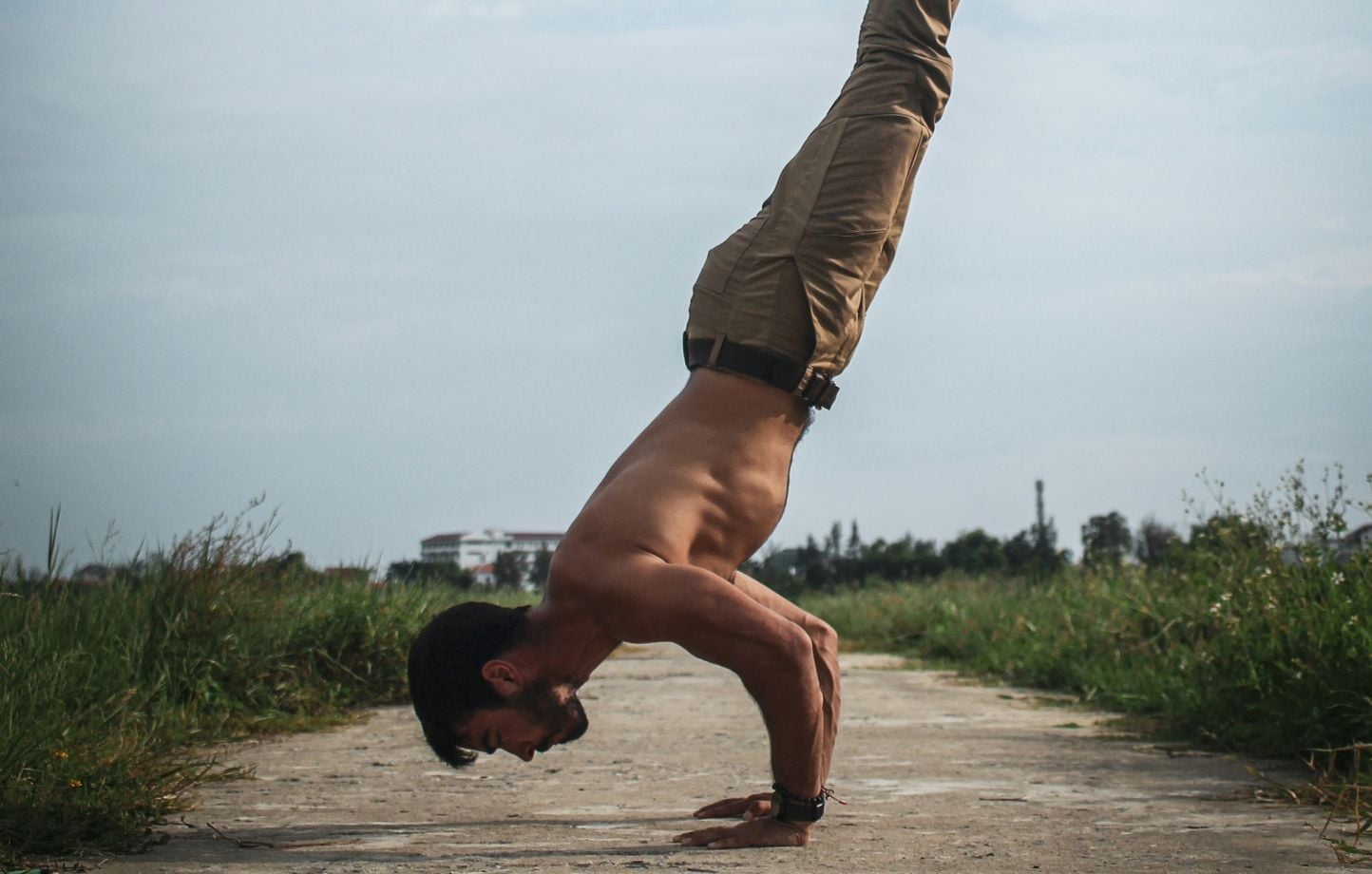
The more you see these impressive figures on video, the more calisthenics, this very fashionable sporting practice, seems inaccessible to you. However, Brieuc Le Dantec, calisthenics practitioner and author of the book “My calisthenics program” (Ed. Marabout) assures that he was “anything but an athlete”, without “any coordination” when he started this discipline. HAS 20 Minuteshe gives some tips for understanding, in a few weeks, this sport with its spectacular postures.
What is calisthenics?
Calisthenics is indeed a sport in its own right. “It’s a discipline which consists of developing one’s physical abilities, with the body as the only tool,” explains Brieuc Le Dantec. Not to be confused with street workout, even if they have common codes: outdoor practice, body weight exercises only. Nor with bodybuilding, because in calisthenics, the main objective is not hypertrophy (gaining muscle mass), “although it allows physical transformations”, recognizes the athlete.
“Calisthenics has existed since Antiquity,” says Brieuc. The word comes from the Greek “kallos” (beauty) and “sthenos” (strength), which translate the two objectives of this practice: aesthetics and strength. But today, calisthenics is approached as a practice aimed at a more functional body, improved balance, better proprioception, power, agility, better joint longevity, and of course the development of strength to control your body when naturally learning certain figures.
Overcoming your fears, the key to progress in calisthenics
In calisthenics, you don’t need to have big muscles to progress. Obviously, you have to work on your strength, your core and nervous work, but it is not necessary to develop your shoulders excessively, because strength and muscular volume are not equivalent.
As proof, the simplest postures when starting out in calisthenics are balance, also known by the English term “handstand”, and the flag. As impressive as they may be, “we can achieve it in an hour if we already have enough strength, or in a few weeks if we start from scratch,” assures Brieuc Le Dantec.
To succeed in achieving balance, for example, the main obstacle is often the “psychological barrier”, which prevents you from crossing the threshold. “If we overcome fear for these two figures, we can achieve it in two months with regularity, and without prior mobility,” says the calisthenics practitioner, who encourages not to underestimate yourself, whatever your age or gender.






Leave a Reply