
“You know if something smells good and something doesn’t.”
As a player and a coach, Thierry Henry has experienced the highs and lows of a World Cup campaign from every angle. The former France striker and Belgium assistant coach says he usually “has a feeling” around a camp on the eve of a tournament.
In 1998, at the age of 20, he was an unlikely pick who ended the competition as both France’s top scorer and a champion of the world.

Henry celebrates a goal with France teammate David Trezeguet during the 1998 World Cup. (Pedro Ugarte / AFP via Getty Images)
In 2006, he was a beaten finalist against Italy.
In 2002 and 2010, he was part of French teams that capitulated in the group stages.
As an assistant coach, he supported head coach Roberto Martinez in guiding Belgium at the 2018 tournament, when the team reached the semifinal before losing to France, and in a disappointing campaign in 2022, when the team failed to get out of their group.
Having been involved in six of the past seven World Cups, Henry is in demand by broadcasters and sponsors for the tournament in North America this summer.
He will be a studio analyst for Fox Sports coverage in the United States, and he is speaking to The Athletic as part of a promotion for Tequila Don Julio 1942, for which he stars in a commercial alongside double U.S. women’s national team World Cup winners Tobin Heath and Christen Press.
Seventy days out from the 2026 World Cup, the identity of the 48 nations participating has been confirmed.
Before anyone can succeed or fail at a tournament, however, they must actually get there.
For coaches and players, now begins the most agonising period of all. For players, particularly those vying for a place in the most competitive squads, the uncertainty is palpable, as they await a phone call from the coach and a plane ticket to the tournament.
For coaches and fans, these final weeks of domestic club seasons will be watched through their fingers, praying that injuries do not befall their most treasured players.
In 1998, Henry was an emerging talent at Monaco, still only 20 and more of a wildcard pick.
“I had some difficulties towards the end of that season,” he tells The Athletic. “I was on nobody’s list (to go to the World Cup). Sometimes the media predicts who is going, who are the ‘maybes’, and who could be the surprise picks. I was not even among the surprises.”
Henry played in every game of France’s run to the final in a home tournament, scoring three goals. Unburdened by the innocence of youth, he did not obsess over the pressures of a tournament in the way that he says more senior players often do. “I was just ready to break everything and just go out there and run,” he grins.
He had been promised by coach Aime Jacquet that he would play some part in the final, but France were 2-0 up against Brazil when Marcel Desailly’s red card reduced the team to 10 men. Henry watched the entire game from the bench.
“I don’t think about Thierry Henry. I think about France,” he says. “I remember in the final, just realizing that I was about to be a world champion. At one point, I looked at the clock and I knew we were 3-0 up. But I was still looking at the time and thinking, ‘Something’s gonna happen, this is weird, we’re about to be world champions.’ I remember thinking: ‘Can they (Brazil) score three goals in 10 seconds?’ I didn’t want to jump too early, although you knew it was done. Then when the ref blew the whistle… I was 20… It’s just like something that you don’t believe, which you dream of, because that was also France’s first World Cup.

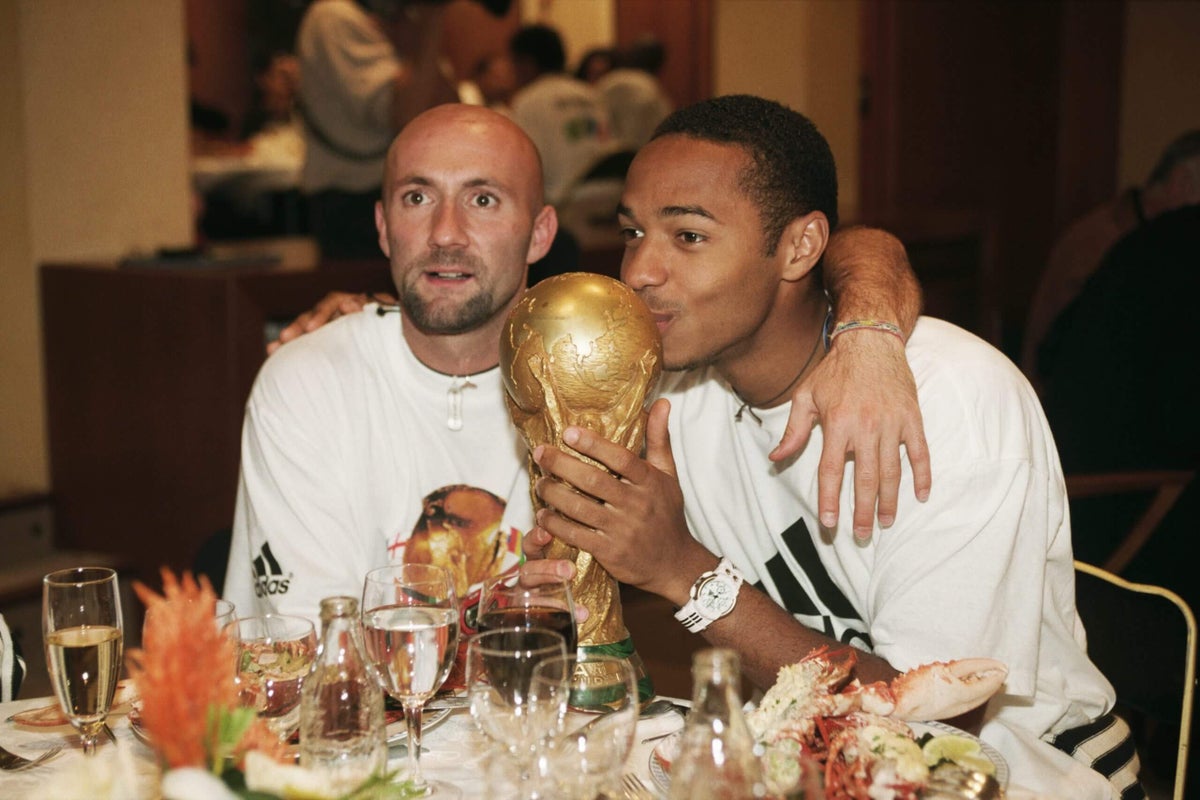
Henry kisses the World Cup trophy after the 3-0 win against Brazil. (Antonio Scorza / AFP via Getty Images)
“I didn’t grow up seeing France winning it. The generation before won the Euros in 1984, but they lost two World Cup semifinals (in 1982 and 1986). It was always the thing that France could never do.
“You finally get over the line and everything comes back; how you started, how I nearly didn’t make the squad, too many things at once.”
For Henry, his first World Cup was his greatest. In 2002, he came off a Premier League and FA Cup double with Arsenal and was one of Europe’s best strikers, while France also won the Euros in 2000. Then France lost the opening match against Senegal and never recovered.
“2002 was a big shock because we were the best team in the world by a distance,” he says. “We were at our peak and, unfortunately, I arrived injured. Zizou (Zinedine Zidane) arrived injured. Things didn’t look the same way.
“Then, in 2006, we wanted to show everybody, ‘Hey, we’re back.’ We fell short in the final against Italy and lost on penalties. We had a great history against Italy by beating them in ’98 in the quarterfinals and in Euro 2000 in the finals. It was just their turn.”

Henry removes his runners-up medal after the 2006 final defeat to Italy. (Aris Messinis / AFP via Getty Images)
As both a coach and player, Henry has experienced the highs and lows of a World Cup campaign. He says he usually “has a feeling” around a camp on the eve of a tournament. “You know if something smells good and something doesn’t.
“Sometimes you have reasons for that. I will give you the first one. As players, you don’t have the opportunity to prepare for a tournament. Sometimes, guys from big teams join late after the Champions League final. They arrive and there is no real cohesion.
“When an athlete goes to the Olympic Games, they prepare for six to seven months to be able to perform. As a footballer, you don’t have the chance to prepare for the World Cup. You come after 70 games and then people say you’ve got to perform now, with all those games in your legs or the pressure of this or that.
“Then people arrive in camp injured or have to go above an injury. If you see one of your best players in that way… it creates in the press or among the fans a little doubt that sometimes you carry throughout the whole tournament because the guy is not ready. There are so many components.”
Then, there are the tournaments where it all comes together, where players arrive fresh and fewer of them are embroiled in last-gasp title fights or high-octane finals.
“When you just lost a final (for your club), you have to play again and perform in (a different competition)… mentally it is not easy. I saw it as a player and I saw it even more as a coach.

Henry, centre, was a losing Champions League finalist in 2006 with Arsenal before heading to the World Cup. (Gabriel Bouys / AFP via Getty Images)
“I think about the preparation as an assistant coach. Some guys arrived and had played 70 plus games, but some had played 40, some 15, and some were injured. You have to get them to the same physical level in 10 days. How do you do that? You can’t push the guy that did 72 games, but you have to push the guy that had 40 games, and you have to kill the guy that doesn’t have enough time (to be ready).”
An example for Henry came in the Belgium squad in 2018, when forward Eden Hazard arrived with far more games under his belt at Chelsea that season than centre-back Vincent Kompany at Manchester City, who at that time needed to manage his body extremely carefully.
“You can’t push Eden too much, but you have to push Vincent a bit more… but you can’t push it too much because you don’t want him to get injured again. Those are the two extremes. That’s something that I couldn’t care less about as a player. I trained, finished, and went to chill. Then I see it from the other side. I’m like, ‘Oh, that’s what it is!’
“Sometimes coaches were asking me how I felt and I’m like, ‘I’ll tell you later.’ There is no later! We need to prepare for the training session! So I became the guy asking, ‘Are you training? Are you not training? Where are you at? How are you physically? I need to know now because we cannot lose time.’”
The challenge is not only physical, but also about psychology and harmony. France, this summer, have an astonishing array of attacking talent. Kylian Mbappe, Ousmane Dembele, Michael Olise, Hugo Ekitike, Rayan Cherki, Desire Doue, Bradley Barcola and Marcus Thuram will all be in the frame for Didier Deschamps’ side.
Henry, who coached the French team that finished runners-up at the 2024 Paris Olympics, has particularly fond memories of coaching Manchester City’s unique playmaker Cherki.
“The ball is not his enemy, that is for sure,” says Henry, smiling. “Rayan is a joy to work with. Easy on the eye. Right foot, left foot: I never saw a guy who could do exactly the same thing at any speed. Any skill you want with both feet, he is outstanding.

Cherki warming up before a game at the Paris Olympics. (Nicolas Tucat / AFP via Getty Images)
“He can change the course of the game just like that,” Henry says, clicking his fingers. “He knows it. We need to find a way for him to be comfortable on the field. When he’s in that space, it can be very good, and in terms of work, he knows he is not the finished article.”
So, how does Deschamps decide between all those talented attacking players?
“It will always be about balance,” says Henry. “But we are blessed in France. It’s on Didier to make sure that he can find that cohesion. But when you look at other teams, you can say the same when you look at the Portugal midfield. England, the team that they have. Messi and Argentina. But I’m French. That’s who I’m going to root for.
“A big thing at the World Cup is to keep everyone happy, even the guys that don’t play. During the tournament, it’s not an easy task and something to deal with, to keep everyone pulling in the same direction. That’s not easy. I realized when I crossed the line to the other side as a coach, trying to lift people who didn’t play, as everyone wants to help. But Didier’s record at the World Cup is just ridiculous really and he can do it.”
Since Deschamps took over after Euro 2012, France’s record in major tournaments is: 2014 World Cup (quarterfinalists), Euro 2016 (runners-up), 2018 World Cup (champions), Euro 2021 (round of 16), 2022 World Cup (runners-up), Euro 2024 (semifinalists).

Henry at the Tequila Don Julio 1942 launch
As for tactics, does Henry expect set pieces during this World Cup to have the emphasis we have seen, in particular, in the Premier League this season?
“How did we win the World Cup in 1998?” Henry asks, frowning.
France’s opening two goals by Zidane were both headers from corners.

(Dimitri Iundt/Corbis/VCG via Getty Images)
“How did Marseille win their only Champions League?”
Basile Boli headed in from a corner to defeat Milan in 1993.
“How did Man United win the treble?”
From two corner kicks against Bayern Munich in the Champions League final in 1999.
“With Belgium, how did we lose our semifinal against France in 2018?
A Samuel Umtiti header from a corner.

(Adrian Dennis / AFP via Getty Images)
“That’s it,” he shrugs. “That’s my answer. I do not know why people are making a big fuss about a thing that has always been there.
“It is not a before or after. As teams have a set-piece coach now, they go a tiny bit deeper about it. But so many times the game has been unlocked or won in that way.
“Even our France final, also in 2006 against Italy, it was decided on penalties… but how did Italy equalise? Marco Materazzi — a header from a corner.”


Leave a Reply