
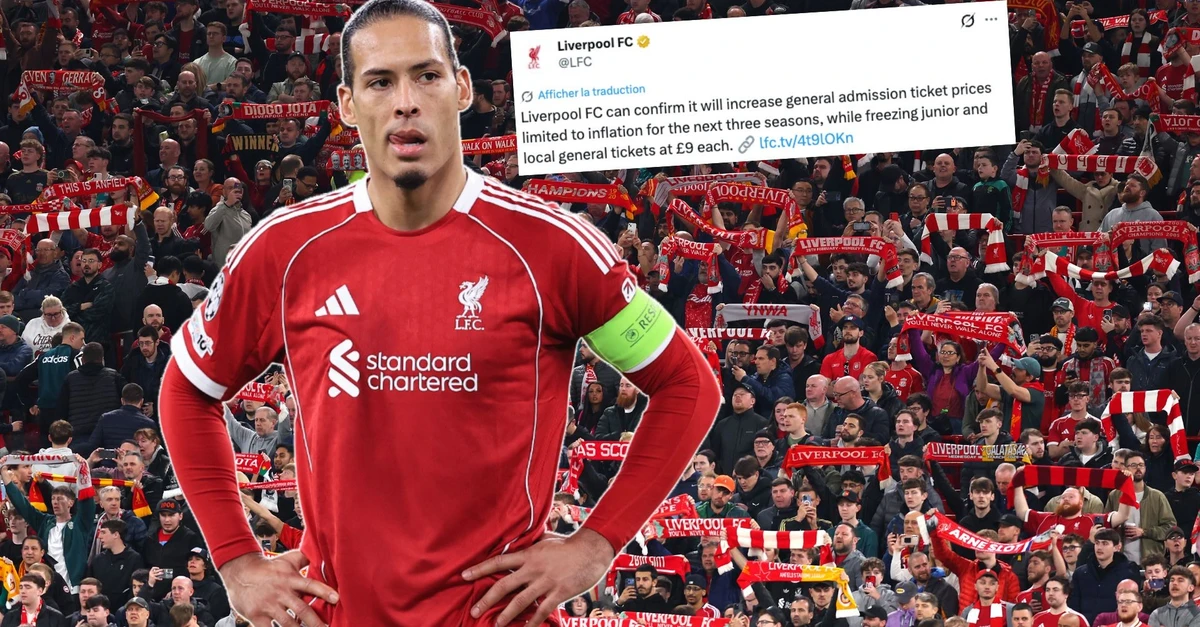
Liverpool FC announced a decision on March 26 that did not please its fans. image: watson
The Reds have decided to increase ticket prices in line with inflation. A trend in the Premier League, which threatens the atmosphere in the stadiums and the popular essence of this sport.
02.04.2026, 18:5702.04.2026, 18:57
Kieran CANNING
Full stadiums and screaming fans. The prestige of the Premier League obviously rests on its stars and the quality of its football, but it is also due to its unique atmosphere in the stands, which some believe is threatened by the ever-increasing price of tickets.
The observation, first of all. According to a recent UEFA report, the “Big Six”, that is to say the six main English clubs – Arsenal, Chelsea, Liverpool, Manchester City, Manchester United and Tottenham – saw their ticket revenue increase by 20% this financial year compared to the previous season.
A commercial strategy which is part of the intense fight between big teams to attract the best players. As such, TV rights and sponsorship remain by far the main sources of income for Premier League teams. But, faced with their relative stagnation, they are also now opting for revenue growth on match days – tickets included –, investing in ever more modern and ever larger stadiums.
Target day visitors
The latest decision to make a big splash, that of Liverpool, one of the most popular clubs in England. The Reds announced in late March that ticket prices would increase in line with inflation over the next three seasons.drawing the wrath of the “Spirit of Shankly” supporters group accusing them of “ignoring those who make Liverpool FC what it is”.
Liverpool fans will have to pay more for their tickets over the next three seasons. Image: getty
And although the expansion work at Anfield has increased its capacity to 61,000 seats, only 34,000 subscriptions are sold, with the aim of targeting day visitorsa more spending clientele, particularly on derivative products.
The idea is to “look at the return per fan, per match,” says football finance expert Kieran Maguire.
“You will get more money from a person who comes to have a (unique) experience than from a grumpy old man who has been there for 50 years”
Offers VIP contested
Same story in wealthy west London, where Fulham goes all out on its “hospitality offer”, with a stand with a rooftop swimming pool and high-end catering, and where the average price of annual subscriptions is among the highest (up to 4,000 euros).
“The Riverside stand is a fantastic asset,” Simon Duke of the Fulham Supporters’ Trust told AFP, although he noted that it “is expensive for the average supporter”. He suggests:
“Thanks to the owners, but can you use it to keep football affordable in the other three stands at the stadium?”
Craven Cottage, the legendary Fulham stadium, is not the most accessible in terms of wallet.image: Keystone
These VIP offers sometimes exceed 6,000 euros per meetingas for the next clash between Manchester City and Arsenal, at the Etihad Stadium, on April 19.
“Some clubs look at their stadium and see every seat as a simple opportunity to make money,” comments Niall Couper, whose “Fair Game” organization warned in a report against this strategy.
“If the club wants to be sustainable and financially viable, keeping ticket prices affordable and allowing access to the local community remains the safest route.”
Sacred union between fans and general grumbling
At Manchester United, the price of season tickets to access Old Trafford has also increased, by 5%. for the third consecutive season. And some discounted rates are also on the rise.
Last year, Reds Devils fans joined forces with Liverpool fans – fans of England’s two most successful clubs – to promote a “Stop Exploiting Loyalty” campaign during a match at Anfield.
Faced with this growing discontent, Premier League clubs can boast of a consistently high average attendance, with just over 40,000 spectators per match, in stadiums almost 99% full.
But warning signs exist, like at Tottenham, in sporting difficulty (17th and in danger of relegation) and which has not managed to fill its 63,000-seat stadium for Champions League matches this year.
The Tottenham Supporters’ Trust warned:
“Far too many empty seats and too many supporters, especially younger ones, excluded due to prices. The more the stands are sparse, the more we harm the atmosphere.
We risk seeing even more empty seats in the Tottenham stadium. Image: keystone
Added to this is an increasingly constrained purchasing power for British households. But in a country where going to the stadium is almost a religion, expert Kieran Maguire believes that clubs still have room for improvement.
At the time of “budgetary decisions” between vacations, restaurants, pubs and football, “the subscription will remain the priority,” he assures.
(afp/yog)
More sports articles







Leave a Reply