
From time to time, a sports marketing executive will urge Premier League clubs to consider an end-of-season play-off system.
It never gets anywhere, but the general idea is that the league table would “split” towards the end of the campaign, allowing a short series of games where the stakes at the top and bottom would be even higher and the excitement would escalate to fever pitch.
It is an idea synonymous with American sport, but something similar has been adopted in various European football leagues — Belgium, Greece, Scotland — in recent years. A dramatic three-way fight for the Scottish Premiership is approaching its denouement with leaders Heart of Midlothian facing fifth-placed Hibernian, second-placed Rangers, fourth-placed Motherwell, sixth-placed Falkirk, and third-placed Celtic in the space of three weeks.
There has never been any real appetite for it in the Premier League, even before you consider that the schedule is already at breaking point and the straight home-and-away format is sacred, having governed every English top-flight season since the Football League was founded in 1888. It ain’t broke. Don’t fix it.
The traditional format brings balance, integrity, stability, and a purity whereby every fixture is weighted equally.
What it rarely throws up is a title showdown as critical as that which awaits Manchester City and Arsenal on Sunday.
On Wednesday, the Premier League’s website published an article declaring Sunday’s clash at the Etihad Stadium “the biggest game for years”. That was the view of former Liverpool forward Michael Owen, who said that “because it’s so close to the end of the season (…) it’s going to slingshot whoever wins, probably, to the title”.
Former Manchester United defender Gary Neville called it an “enormous game” and a “monstrous clash” that will “define the Premier League season”. It is hard to disagree.
There is an unashamed tendency towards hyperbole in sports media. Not every big game is as big as the build-up suggests. There are 380 games over the course of a Premier League campaign. How many are genuinely season-defining? Very, very few.
The last true “title decider” in English football’s top flight came at the end of the 1988-89 season, when a game between champions Liverpool and challengers Arsenal had to be rescheduled following the Hillsborough disaster. It ended up as the final game of the season, with Arsenal needing to win by at least two goals at Anfield to be crowned champions at Liverpool’s expense. It came down to the final seconds of the campaign when, with Arsenal 1-0 up, Michael Thomas — “charging through the midfield… it’s up for grabs nooooow” — scored the goal that ended Arsenal’s 18-year wait for a league title.
That was another era, a title-deciding game rescheduled in exceptional, tragic circumstances.
Across the previous 33 seasons of the Premier League era, how many times do you suppose the teams in first and second have faced each other this late in the campaign — leaders Arsenal have six games remaining, second-placed Manchester City have seven — while separated by as few as six points?
The answer — once you have disregarded the various dead-rubbers (like when Liverpool played Arsenal last May, having already secured the title) and those games when the leaders were more than six points clear — is just seven.
Even the last of those, three seasons ago, might be a questionable inclusion when you consider that Manchester City still had eight games to play (to Arsenal’s six). Likewise, the game at Anfield in April 2014, by which time the real threat to Liverpool was not second-placed Chelsea, but third-placed Manchester City, who went on to win their four remaining games and secure the title.
The point is that these occasions — such high stakes, so late in the season — are rarities. The title race will not be won or lost on Sunday, but the game at the Etihad Stadium feels pivotal. Should Manchester City win, they will be within three points of Arsenal with a game in hand. A draw, maintaining a six-point lead, would see the pendulum swing firmly in Arsenal’s direction. Should Mikel Arteta’s team win to move nine points clear, they will be overwhelming favourites once more.
A look at the list above underlines just how important these games can be.
To take them in turn:
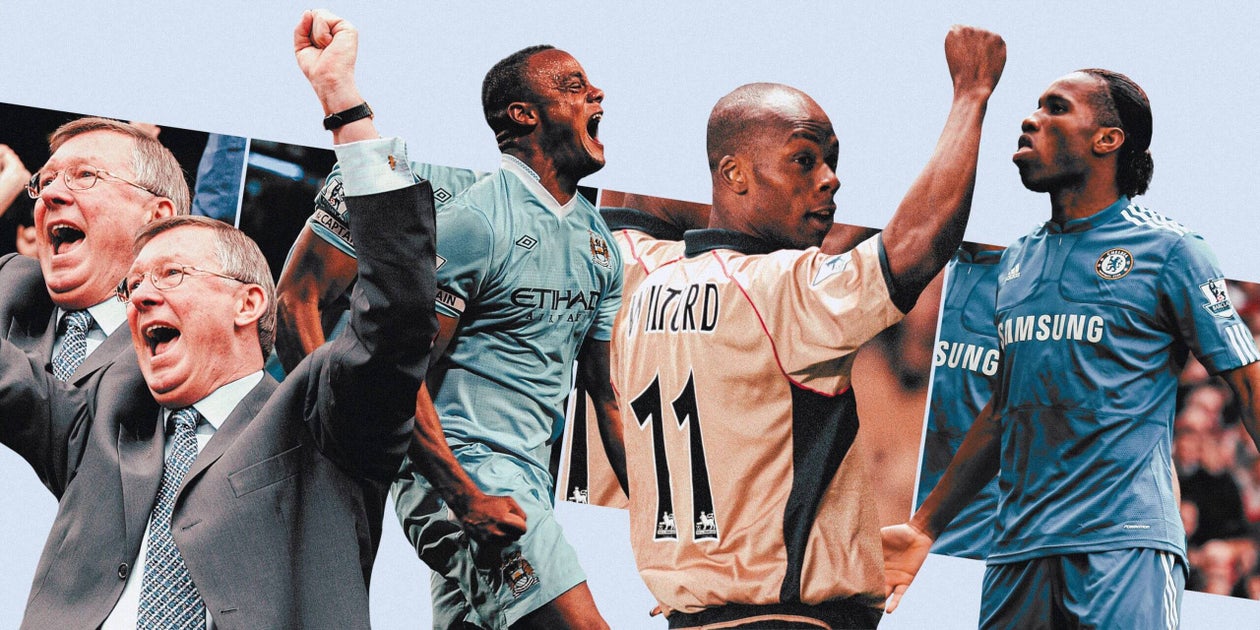
- May 8, 2002: Manchester United needed to beat Arsenal at Old Trafford in their penultimate game of the season to take the title race to the final day. Arsenal won 1-0, thanks to Sylvain Wiltord’s goal, to end their rivals’ run of three consecutive league titles.
- April 16, 2003: A Ryan Giggs equaliser earned Manchester United a 2-2 draw at Arsenal, keeping their five-point lead intact (but having played a game more). They went on to win the title with a game to spare.
- April 26, 2008: Chelsea beat Manchester United to move level on points, but Sir Alex Ferguson’s team had a superior goal difference and won their final two games while their rivals faltered.
- April 3, 2010: Chelsea, one point behind at the start of play, won 2-1 at Old Trafford, with Ferguson furious about the decisive goal, scored by Didier Drogba from an offside position. With a one-point lead, Chelsea won four of their next five games to secure the title on the final day.
- April 30, 2012: Manchester City beat Manchester United 1-0 to move level on points with two games remaining. A dramatic final day saw them clinch their first league title in 44 years on goal difference thanks to Sergio Aguero’s stoppage-time winner against Queens Park Rangers.

Manchester City left it very late in the 2011-12 title race (Paul Ellis/AFP Photo via Getty Images)
- April 27, 2014: Liverpool’s first league title since 1990 was within touching distance, but captain Steven Gerrard’s slip put Chelsea on course for a win. Manchester City leapt from third place to win their second title in three seasons.
- April 26, 2023: Arsenal, having led the table for much of the season, were running out of steam, and Manchester City, inspired by Kevin De Bruyne, showed them no mercy. Manchester City, in the midst of a run of 12 consecutive Premier League wins, were crowned champions with three games to spare.
The closest thing to a true “title decider” was that Manchester derby in April 2012; a game which, with nearly 14 years’ hindsight, can be seen as pivotal in terms of the balance of power in the Premier League as well as during the season in question.
Manchester City’s then-captain Vincent Kompany recalled years later, in the club’s 93:20 documentary, that “it seemed like this was the only game that day in the world”. He said he and his team-mates had heard in advance about the huge number of people who would be watching worldwide, “some to support who were at the time the giants (Manchester United) and others to see an upset because they knew how crucial this game was. The fact that it was a derby just multiplied everything that was important about this game”.
“A shootout,” Ferguson called it in advance, “the derby game of all derby games”, adding that “whoever loses will be tinged with regret”.
That was certainly the case for his Manchester United team, who, knowing that a draw would maintain their three-point lead at the top, were far too passive, failing to get a single shot on target as Manchester City won 1-0 thanks to a Kompany header. Ferguson said afterwards that he firmly expected Manchester City, with a superior goal difference, to win it from there. They did, even if, ultimately, it came down to the dramatic final seconds of the campaign.
Going back to those seven top-of-the-table clashes between 2002 and 2023, one was drawn and five of them were won by the team with the greater momentum behind them. To that, you could add some other famous wins that came a little earlier in the run-in — Manchester United away to Newcastle in March 1996, Arsenal away to Manchester United in March 1998, Manchester City away to Arsenal in February 2023, a couple of months before they met again — but cemented the feeling of one team peaking at the right time, while the other lost their way from a winning position.
That sounds ominous for Arsenal ahead of Sunday, given the dramatic change in momentum and mood since they met Manchester City in the Carabao Cup final a month ago.
At the time, Arsenal were nine points clear of Manchester City at the top of the Premier League (albeit having played a game more). Manchester City had won just one of their previous five games in all competitions, beaten at home and away by Real Madrid in the Champions League. Manchester City’s 2-0 victory at Wembley seemed to re-energise their campaign and plunge Arsenal into doubt.
Recent weeks have reinforced certain perceptions of both teams, which is strange when, for much of this season, Arsenal looked the more resilient, more focused side. Whether Sunday’s game conforms to the narrative of the past few weeks, or the first seven months of the campaign, remains to be seen.
Looking back through recent history, the momentum built up over a number of weeks often appears to carry more weight than the history built up over many years.
Manchester United were established as serial winners under Ferguson, but even they were susceptible to late-season wobbles: that decisive loss to Arsenal in 2002 came after they had been overtaken by Arsene Wenger’s team and knocked out of the Champions League by Bayer Leverkusen; the loss to Chelsea in 2008, though it proved surmountable, followed nerve-fraught draws at Middlesbrough and Blackburn Rovers; that defeat by Chelsea in 2010 came four days after they lost away to Bayern Munich in the Champions League quarter-final first leg; the fateful Manchester derby defeat in 2012 saw the evaporation of what, four games earlier, had been an eight-point lead at the top.
In the second half of the 2002-03 season, by contrast, Manchester United went 13 games unbeaten in the Premier League (11 wins, two draws), overhauling a seven-point deficit to establish a five-point lead over a seemingly unstoppable Arsenal team that had run out of steam. A 2-2 draw at Highbury in mid-April wasn’t conclusive, but Ferguson’s body language at the final whistle — striding across the turf, fists clenched, congratulating his players, saluting their supporters — was that of a manager who wanted everyone to know the momentum was entirely with his team.

Sir Alex Ferguson’s body language suggested he felt a point for Manchester United at Arsenal might be decisive (Tom Hevezi/PA Images via Getty Images)
Arteta and his players would be entitled to a similar reaction should they leave the Etihad Stadium on Sunday with their six-point lead intact, or indeed enhanced. Should Manchester City win, the outlook might be rather less favourable for Arsenal than the league table — still top, three points clear, one more game played — would suggest.
There will still be five games for Arsenal to play — six for Manchester City — and, in a season in which neither has yet made a wholly compelling case to be crowned champions, there will still be scope for more twists over the final weeks.
But make no mistake, Sunday is big, not least because of what winning this Premier League title — or missing out on it — would mean for both clubs.
Manchester City, having lost their crown to Liverpool last season, are desperate to return to pre-eminence amid persistent doubts over Pep Guardiola’s future and the ongoing wait for a resolution in the Premier League’s case against the club for alleged breaches of financial regulations.
Arsenal’s fans, by contrast, might be wondering whether they will ever get a better chance to win a first league title since 2003-04. Manchester City, who pipped them in 2022-23 and 2023-24, have struggled for consistency over the past two years, and Manchester United, Chelsea and last year’s champions Liverpool have not been in the race. If not this season, for Arsenal, then when?
Above all, what makes Sunday’s game so significant is the timing of it. It is such a rarity for the top two teams in the Premier League to go head-to-head so late in the campaign with the title race unresolved. It will not be decisive — not quite — but, just for once, the hype might be justified.




Leave a Reply