
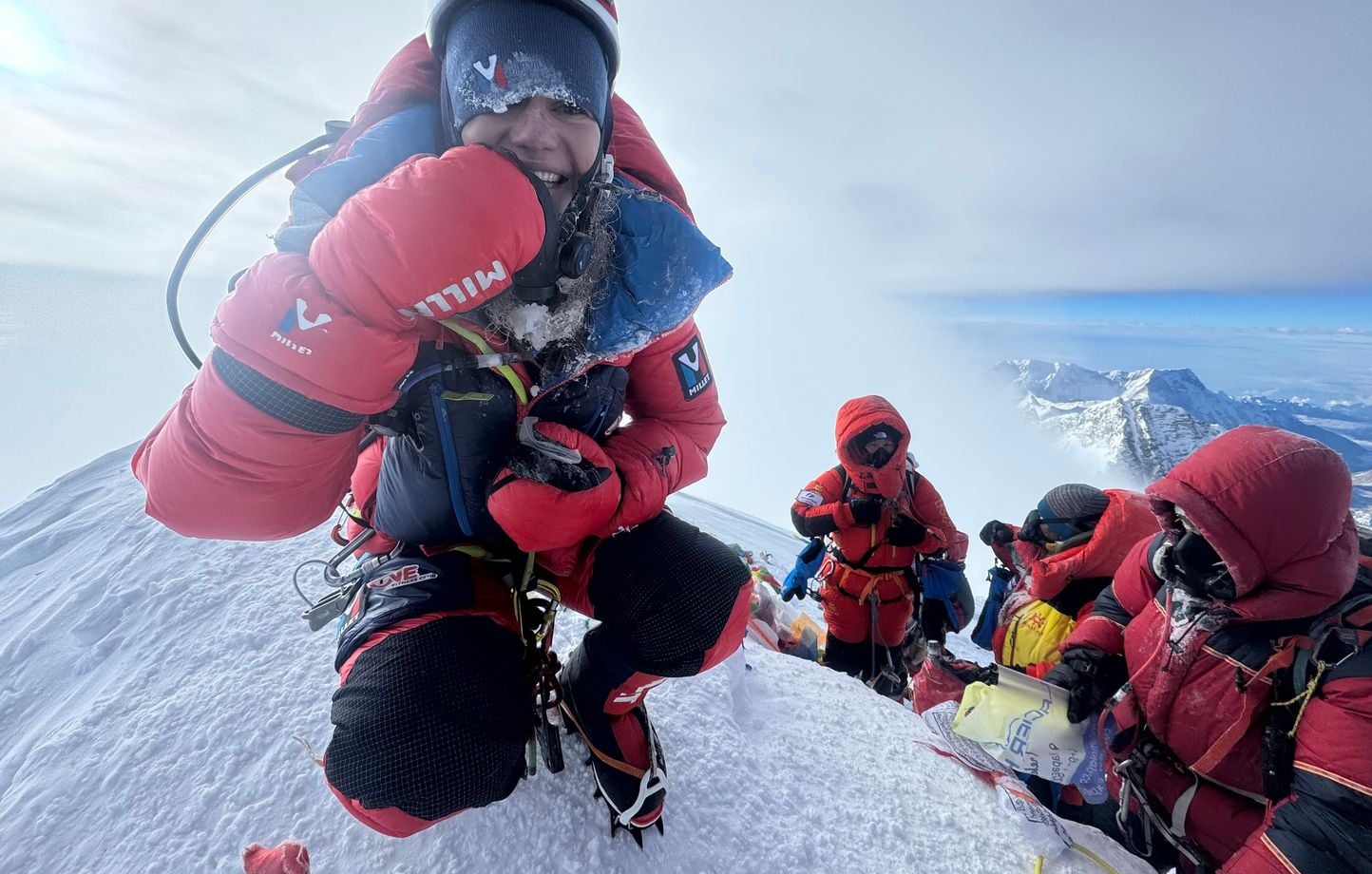
Last May, Constance Schaerer became, at 26, the youngest French woman to reach the summit of Everest. Not her first feat, since the Alsatian had already climbed Kilimanjaro in Africa, Aconcagua in South America and Denali (or Mount McKinley) in North America. The young woman took on the challenge of reaching the highest peaks on each continent, in order to fulfill a wish of her father Marc, who died of pancreatic cancer when she was 9 years old.
While waiting to complete her collection with Elbrus (Europe), the Vinson massif (Antarctica) and Puncak Jaya (Oceania), she presents the film of her ascent to the Roof of the World, this Thursday evening at the Grand Rex.
Nearly 1,500 people are expected in the famous Parisian venue*, an incredible success for her, starting from a blank page in 2021. Since then, she has created her association “7 summits against illness”, which supports children who have a parent with cancer or who have lost a parent. Sébastien Loeb, Fabrice Amédéo and Mehdi Zidane, Zizou’s nephew, are the godfathers, and many other personalities have already given their support. Constance Schaerer, now followed by nearly 100,000 people on Instagram, tells us about this crazy adventure which is “still in its beginnings”, she swears.
*Doors open this Thursday evening at 6:30 p.m. There are still places left
What does this evening at the Grand Rex mean to you?
An accomplishment, and a great recognition. Finding yourself at the Grand Rex when you started an ultra-personal project four years ago is great. It is still the largest cinema in Europe, and the most beautiful too. It was the goal, at the beginning, to bring together lots of people around this project, and today we are getting there, little by little. Even if the biggest climb, that of Everest, has passed, it is still only the beginning of the story. It’s going to be great in any case, it’s cool to say that we’re able to make films, to follow our dreams.
Did you imagine, before Everest, that it would represent such a change for you?
I knew there would be changes, because climbing Everest is the one we talk about the most. And I also knew that if I reached the Roof of the World at that time, I would be the youngest French woman to have done so and that would change the course of history a little. Afterwards, I tried not to think too much about what happened next, what the impacts were going to be, etc. Firstly, so as not to put pressure on myself in my expedition and to really be able to live my project 100%, and also because if you imagine too big, you may experience some form of disappointment. So I let myself go, telling myself that we would see. In the end, it’s great because the impact hasn’t stopped after a month or two, it continues to grow, we have a lot of projects in progress, requests, things that interest me a lot.
You have met a lot of people over the last five years, like Mike Horn, Christine Janin and Jacques Marmet. Who impressed you the most?
I still want to say Christine Janin, she is the first woman who reached the end of the challenge of the seven summits, the first French woman to the summit of Everest, she also created an association (“To each their own Everest”). She has taken her boat really far, and we have a lot of similarities in our profiles, in the determination, the desire to do great things, to support the children. But afterwards, everyone was super inspiring. Over the last four years, I have felt a lot of mutual help and support, from people who really wanted to be there. This is the most rewarding thing today, experiencing these successes together.

In 2022, you climbed Mont-Blanc at the same time as you were writing your final dissertation. The subject was “what are the levers that allow man to generate meaning in the realization of his life”. Would you write it differently today?
Honestly, no, because he really helped me understand what I needed to get involved with. I try to focus on things where we will have a long-term impact, rather than making one shots which follow each other. The goal is to think about the whole year, how we can build it so that it has the most meaning possible, aligned with my values.
The question was also whether the meaning you gave to your life had evolved with this project…
It’s funny because when I wrote this memoir, I already had the challenge of the seven summits in mind. I wrote it for that, precisely, to try to understand where I should go, what path I should take, because at that moment, it was hard to choose. I was coming out of business school, I could have had a great job in a great company, it’s hard to say to yourself “go ahead, I’m leaving everything and I’m going to do something else”, when your friends sign their first permanent contract. These are difficult life choices to make.
When you climb Everest, is it hard to motivate yourself to go back? Isn’t there a kind of decompression?
I haven’t felt that since the climb, but also because it hasn’t stopped. It’s been a race against time since then, I’ve had very few moments off, of reflection. Thursday’s screening is precisely the last chapter of Everest, then I’m going to move on to something else, a big project that we will also announce on this occasion. So for now, I haven’t had this moment of downbut it will happen and that’s normal, it has to calm down too, I can’t live at 100 miles an hour all the time.
Do you know approximately when you will leave for the three remaining summits?
We will make announcements on Thursday, but basically, the plan is to have completed this challenge by mid-2027.
Are you already imagining what your life will be like next?
Oh, it will always be so dense and intense, because I don’t know how to stop. I always have lots of ideas, lots of things that I want to develop and create. My life at the end of the seven summits will be around my association, continuing to help these children, in connection with national education, hospitals, psychologists. And obviously there will still be a lot of challenges. I want to have a somewhat “French adventurer” position, discovering all the mountain sports, and also those which are somewhat in the same worlds, sailing in particular.

Do you ever think about the life you would have had if your father were still here?
Yes, I think about it often, really. I miss him and I say to myself, damn, I wish he was here, that he saw that. But afterwards, I tell myself that if he were still here, he wouldn’t see it because it wouldn’t exist. I completely accepted the death of my father, that life happened like that. Obviously, there is always this great sadness and this incomprehension, like all children in fact. “Why is this happening to me? Why does cancer affect some people and not others? » Afterwards, I think you shouldn’t look behind yourself. The message that my father wanted to leave me was to live 100%, live intensely, do great things.
And your mother, how does she experience all this?
(She smiles) My mom, it’s not easy every day for her, because already, everything is always revolved around my father. While she is extremely present for me, she gives herself body and soul for this project, for the association. At first, I don’t think she really believed in it, there was this reluctance. There, she is realizing what is happening, the excitement that there is around all this, about the association. When she also sees the families we support, the exchanges she can have with the parents, when she sees the children, it is impossible to be insensitive. In any case, we are very close, she supports me 1000% and she tries to be there as much as she can to help me. I have a great mom, yes.

Leave a Reply