

Declan Rice started this week in his sick bed but that did not stop him playing 94 minutes against Sporting CP to help Arsenal reach the Champions League semi-finals, in a typically relentless display.
It also did not stop him from bringing up a familiar theme in his post-match comments. In three separate interviews before and after the second leg of the quarter-final, Rice pointed out that Arsenal had been confronting back fives when facing opposing defences recently. Two of these occasions were when he was asked about Arsenal’s attack, which has been under scrutiny in recent weeks for scoring three goals in their past five matches.
“It’s tough when you play against back fives,” Rice told reporters in the mixed zone post-match. “We’ve done it more than ever this season — 5-4-1s, 5-3-2s.
“Teams really do set up differently against us. It’s down to us to break that down, but when they are camped on the edge of their box, sometimes it is tough to break down because you’re playing against top-level international players. So there’s a different perspective to it.”
He has a point.
The graphic below shows that no team has dealt with the opposition starting their sequences of play from a deeper point than Arsenal this season (43.4 metres) — meaning that opposition teams win the ball in deep areas and start their attacks from said areas more often against Arsenal than any other team.

The statistics suggest 30 per cent of their build-ups come against low blocks, described by Opta as standard possession play as teams look for attacking/progressive build-ups — also the highest share in the Premier League. That leaves less space into which Arsenal can attack, which has been a growing theme for three seasons.
After seeing Arsenal blow Premier League teams away in the 2022-23 campaigns, when five players scored 10 or more league goals, the general response from opponents has been to restrict space as a counter-measure.
Manager Mikel Arteta addressed this recently during a press conference discussion over the speed at which football has evolved in the Premier League.
Asked whether maintaining attacking style matters in the midst of that evolution when challenging for trophies, he said: “It’s (about) playing the best football that you possibly can, and what the game demands.
“I realised what’s happening (with the increase in man-to-man marking) in the Premier League the other day when I was watching the Champions League game between Newcastle and Barcelona (first leg).
“For me, Barcelona are the most exciting team in Europe, and they faced a Premier League team who are exceptional in their intensity and their high press. Everything is man-to-man. They are a really good team in transition, and we saw a completely different game that I’ve never seen Barcelona play. That’s a huge credit to Newcastle, but this is the league that we are playing in.”

Mikel Arteta on the touchline against Sporting CP (Mike Hewitt/Getty Images)
Barcelona ended up sweeping Newcastle aside 7-2 in the second leg, but Eddie Howe’s side were one of the first to start restricting space for this Arsenal team before the 2022-23 season had ended.
They played out a 0-0 draw at the Emirates that January when there was little movement out of their defensive structure, and a ball-in-play time of just 53 minutes — eight below the season average of 61.
Arsenal have had to constantly find ways to counter this lack of space in the years since, but every action has an equal and opposite reaction.
Speaking to former Manchester United, Bayern Munich, and England midfielder Owen Hargreaves pre-match, Rice said: “There’s a big difference between playing against a back five and a back four. Spaces are not really there as much (against back fives), so you have to move and rotate to drag them out.”
The initial graphic also showed that Arsenal have the highest sequence starts in the league this season (52.2 metres). That is down to them dominating position in most games, so when the ball is lost, it is not uncommon to see William Saliba and Gabriel intervene near the halfway line.
That directly contributes to Arsenal’s strong defensive numbers, as attacks are stopped before they even start.
Winning the ball in such areas makes it almost inevitable that less space in the opposition half will be a side-effect, but solutions still need to be found.
Martin Zubimendi’s runs forward, both with and without the ball, helped create openings against Sporting CP as they did earlier this season. Also noteworthy during the game was what Eberechi Eze brought on his first start since returning from a calf strain. The midfielder did not score, but had four shots from outside the box and was trying things.

Eberechi Eze tried to open up Sporting CP on Wednesday night (Mike Hewitt/Getty Images)
That was an integral aspect of his play that was helping Arsenal before his injury, even in matches in which he was not scoring. He took six shots outside the box against Everton last month, the joint-most in the Premier League this season, and the constant barrage of attempts helped Arsenal gather momentum before their eventual winner.
Arteta also spoke of the importance of those shots from range earlier in the season, saying: “The more density there is inside the box and the more contact there is, the more difficult it is to score goals in open play. So you have to find other ways.”
That was the day before Zubimendi scored from outside the box against Sunderland, and after the game, he said: “It’s situations that you get with time and space. If the space is not in one place, it will be somewhere else.”
Coincidentally, Rice could have scored from an almost identical spot minutes before Zubimendi did against Sunderland. The 27-year-old joked pre-Sporting that Gabriel Jesus tells him he should shoot more from range, and he had an opportunity to put one away in the 2-0 win over Bayer Leverkusen.
“Ten seconds before this happened, I was thinking the ball could come there,” Rice told Hargreaves in that pre-match chat. “For centre-halves, stepping in front of players is a key thing, but as a midfielder when that ball is played, that is where I want to win my duels, get in front of my man and be hungry to win the ball.
“Our manager bangs on about being on the front foot and being ahead of the game. It wasn’t the best first touch, but it still put it in the path I wanted it to go.”
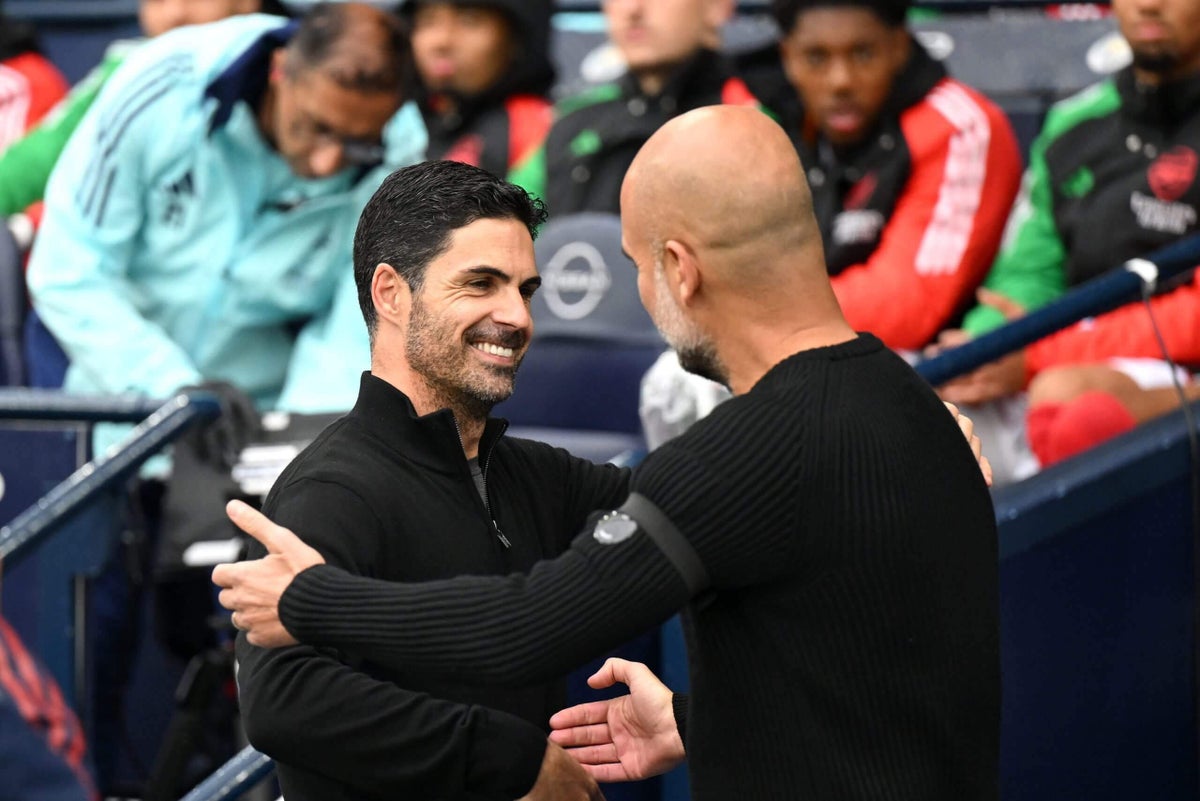
It can be hard to find space and time when teams set up so low, so often, but being on the front foot can make all the difference — and may be necessary even against Manchester City this weekend.
In their 1-1 draw earlier this season, Pep Guardiola’s side started sequences of play from an average of 40.3 metres. That is not only their lowest in the Premier League this season, but the only two matches where they started sequences from deeper since the 2018-19 season came in games against Wolves and Brighton when they had suffered first-half red cards.
Their approach was different in the Carabao Cup final, with four attackers screening the top of the pitch, but their sequence start point of 45.4 metres was still below average.
So do not be surprised if City change their approach against Arsenal, as Rice has cited many teams do.
If that does end up being the case, it may be the biggest chance yet for Arsenal to show they have the armoury to still prevail. That is until they play Atletico Madrid in the Champions League semi-finals at least.








Leave a Reply